
-

We greet all our visitors on this special feast of Our Lady of Mount Carmel and assure you of a place in our prayer during Exposition of the Blessed Sacrament from after Mass until 3.00pm.
We would like to share with you the following reflection by a Carmelite priest.The Virgin of Carmel
P. Javier de la Cruz. The Virgin of Carmel is one of the many titles of Our Lady, perhaps the
most popular and widespread in the church. But there is just one Virgin, who saw the birth of her son in Bethlehem, saw him growing up in Nazareth and then followed him along the dusty roads of Palestine. She was the one who, right from the beginning, knew how to be open to God’s word and listen to it, obedient to his will.
A group of crusaders, who had gone for the conquest of the Holy Land, chose this Virgin of all as their Patron, Mother and Sister. Attracted by the prophet Elijah, they decided to live a hermit life of allegiance to Jesus Christ in the foothills of Mount Carmel, in a narrow valley of singular beauty in which rises the spring of Elijah. The valley is like an immense window looking on to the Mediterranean sea, through which enters the first joyful rays of sun each day. In this place of particular beauty, of immense tranquility and ringing solitude, they established a hermitage in the centre of which they built a chapel in honour of the Virgin Mary – the Virgin of Mount Carmel.
When persecution arose, the few who managed to escape from it returned to Europe and brought with them, as the best heritage and spiritual richness of the Holy Land, devotion to Our Lady of Mt Carmel, who lavished help upon them in an evident manner, just as they were lavish in serving and venerating her and making her known. Among the particular helps given by Mary to her Carmelite children stands out the gift of the Scapular to Saint Simon Stock, when he insistently prayed to her:
“Flower of Carmel, tall vine blossom laden, splendour of heaven… on Carmel’s children thy favours bestowâ€.
From 1250, the Virgin of Carmel became Our Lady of Mt Carmel of the scapular, and no image of her will be found that does not bear the scapular, which someone once called, “a furnace of love lit by a spark issuing from Mary’s heart.â€
The scapular has become the Gospel of Mary, a memorial of her simple and gospel-like virtues, a reminder of her generous heart shedding graces and blessings. At the same time, she constantly reminds us that wearing it is a consecration to the Virgin of Carmel, carrying with it the commitment to live her simple and gospel way of life in service to the Church and humanity.
Popes, some of whom have worn the scapular, have enriched devotion to Our Lady of Mt Carmel with grace and indulgences; Institutions of all kinds and nations have proclaimed her Patron; those working on the sea have taken her as their particular patron and have found in her the best of navigators, the wave of the sea and rower, who always has her hands on the oars and with her the sea is calm and the heavens sweet.
-
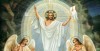
Easter Joy with St John of the Cross
The Cross leads to Resurrection as surely as the darkness of night gives way to the light of the rising sun. This was the faith by which St John of the Cross lived and it was the core of all his teaching. To live in the light of the Risen One is to have passed from death to life. “If we have died with him, we shall also live with himâ€. Through our Lenten self-denial we chose to enter, in however small a way, into that dying to earthly things and physical comforts that must be an integral part of our ongoing faith journey. It is the cost of discipleship and it brings us ultimate joy because it allows the truth of God to fill and satisfy us. Only the glory of the Risen Lord can answer the deepest desires of our soul.
“He took on our human nature and elevated it in the beauty of God, and consequently all creatures, since in human nature he was united with them all. The Son of God proclaimed, “If I be lifted up from the earth, I will elevate all things to myself.” In this elevation of all things through the Incarnation of his Son and through the glory of his resurrection according to the flesh not only did the Father beautify creatures partially, but, we can say, he clothed them entirely in beauty and dignity.”
                             – from The Spiritual CanticleWe wish all our visitors a very happy and blessed Easter. May the Risen Christ bring you peace.
-
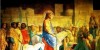
Passiontide with St Teresa
The passion, death and resurrection of Christ constitute the awesome mystery at the centre of our faith, awesome because it concerns the suffering of our God, and yet accessible because suffering is a reality of which we all have experience. St Teresa declares that, “a person will not be right if he says he does not dwell on these mysteries or often have them in mind, especially when the Catholic church celebrates themâ€. But her way of dwelling on them was a very simple one, “I strove to be His companion there…I remained with Him as long as my thoughts allowed me toâ€. She was especially drawn to the gospel account of Our Lord’s agony in the garden before his capture and she reveals a lifelong practice of her own: “Most nights, before going to bed, when I commended myself to God in preparation for sleep, I always pondered for a little while this episode of the prayer in the gardenâ€.
During these days, when the Church’s liturgy unfolds for us again the shocking truth of all that Jesus suffered to conquer sin and death, the simple directness of St Teresa’s approach can be an encouragement to us. She did not try to compose a devout meditation, or to study the theology of our redemption. But she made a personal effort to be present to Jesus in his lonely moments of pain and desolation, silently witnessing his sorrow and staying with him, “as long as my thoughts allowed me toâ€. We can be sure that in our own times of suffering Jesus will do the same. He will stay with us.
-
It was one of the joys of St Teresa in founding a new house of her Reform that she was offering Jesus another tabernacle in which to dwell. During her years as a young Carmelite in the monastery of the Incarnation, visitors to the parlour must sometimes have brought news of what was happening in far away England, for Henry VIII’s suppression of some 800 monasteries began when Teresa was a novice. She must certainly have heard of the destruction of Walsingham in 1538, while she was away from her monastery seeking a cure for her illness. Walsingham was one of the most famous shrines in Europe, a centre of pilgrimage, and it’s desecration would have sent shockwaves through Catholic Spain. Later, while she was preparing for her Reform, she learned of the attacks on the Church in neighbouring France and was especially distressed by the profanation of the Eucharist. She writes, “For nowadays these heretics have so little regard for the Blessed Sacrament that they take away its dwelling places by destroying churches†and again, “it seems these traitors would want Him to be crucified again and that He have no place to lay His head.
We are so accustomed to the easy availability of the Eucharist and frequent Communion that we are in danger of taking for granted the intimate presence of Our Lord. St Teresa was always vividly aware of such a great gift and held it in loving reverence. Her words can help to stimulate our own faith and gratitude.
“The Lord had given this person (herself) such a lively faith that, when she heard people say they wished they had lived when Christ walked on this earth, she would smile to herself, for she knew that we have Him as truly with us in the Most Holy Sacrament as people had Him then, and wonder what more they could possibly want.â€
-
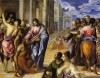
Apologies for last Sunday which was a copy of the previous Sunday. This has been rectified.
In her book, The Way of Perfection, written for her first little group of nuns, St Teresa speaks of prayer in a very spontaneous and accessible way. She says that true prayer consists in simply looking at God, not in thinking much but in loving much. She suggests taking an episode from the Gospel and being present to Our Lord in that scene. She herself liked to look upon Our Lord in his agony in the garden of Gethsemane, believing that, since he was alone he would be pleased to have her company. Her answer to distractions of the wandering mind is to encourage us to turn our gaze again to Our Lord, “just for a moment, if you cannot do moreâ€.
“Just look at Himâ€, Teresa says, because, “He never takes His eyes off youâ€. Have you ever had the experience of scanning a crowd, looking for the face of someone you know is there, someone you love. Suddenly your eyes meet his and you realize he has been looking at you all the time? There can be moments in prayer like that.
-

In the crafty nun section in our shop you will find the latest designs – but in card form. The original artist is our Sr Bernadette from Wolverhampton Carmel, a great cartoonist who was so good  and patient with my promptings and ideas. Also, a few Easter cards coming soon.
-
It often seems that the world we live in is especially challenging to faith, and yet the world of St Teresa of Avila presented, perhaps, even greater challenges. In XVI century Europe the established order was changing dramatically; Christendom was breaking up, entire nations (including our own) were repudiating the Catholic faith, leading Teresa to cry out to God, in words we might well want to echo today, “Is it not enough, Lord, that the world has intimidated us, so that we may not do anything worthwhile for you in public or dare speak some truths…Don’t allow any more harm to come to Christianity, Lord. Give light now to these darknesses.â€
St Teresa’s response to the confusion of her times was to gather around herself a group of women who shared her conviction that the interests of the Church were best defended by prayer, and that prayer itself was the deepest expression of faith.  She communicated the same ideal to the friars, whose ministry was to be entirely grounded in prayer.  Five hundred years later, our own times call for the same response. Our prayer for a world that is often hostile to faith is itself an affirmation of our faith, strengthening our own commitment while being a channel of God’s grace to others.
-
The Carmelite saints have a lot to say about faith. In a few chapters of his book, the Ascent of Mount Carmel (Book2: 1-4), St John of the Cross mentions faith about fifty times. You would think, wouldn’t you, that the mystics, those people of prayer who have reached the closest union with God that is possible this side of heaven, would hardly need faith nay more. But the opposite is true. The closer we come to God, the more faith must deepen because, as John teaches, only faith can expand sufficiently to encompass the whole truth of God.
Our mind and imagination form an idea of God, and each of us has our own image of the God to whom we pray. But as John rightly insists, our mind and imagination are limited – and God is unlimited. Nothing we can think, feel, imagine or experience about God is the full reality of God, and so there will come a point when our idea of God no longer satisfies us. Sometimes it can seem as if we are losing our faith, but in fact we are only losing an image of God we have outgrown and moving into a deeper and simpler faith as God draws us closer.
Our growing in faith will continue all our lives if we are faithful to prayer and ready to allow ourselves to be loved and led by God.
-
On this First Sunday of Lent when the Gospel places before us the forty days of Jesus in the desert, we offer the first of our Lenten reflections.
LENTEN REFLECTION ONE
“The monotony of Sacrifice”St Therese of Lisieux once declared, “To ecstasy, I prefer the monotony of sacrificeâ€. We might feel she had strange tastes and we would choose differently, given the chance. But the point is that, heroic soul though she was, she found sacrifice monotonous.
We embark on our Lenten resolutions with a firm resolve, bracing ourselves for the long challenge ahead, perhaps with a secret sense of our own noble generosity. But the end of the first week finds our enthusiasm flagging and by the end of the second it is all becoming a bit of a bore. Once we have slipped up a few times we can no longer feel heroic and there is a strong temptation to give the whole thing up. As Therese said again, with her keen insight into human nature, “We would like to suffer in the grand mannerâ€.  But her secret was that she never allowed herself to be discouraged by failure. She is not afraid to say of herself, “I am a very insignificant person, who can’t offer to God anything but insignificant sacrifices. Sometimes I miss the chance of making them, sacrifices that give me such peace of soul; but I don’t lose heart, I just resign myself to the loss of one peaceful hour, and try to be more on my guard another timeâ€.
To humbly renew our efforts and keep going, when our Lenten performance is already looking a bit tattered, will lead us more deeply into the celebration of our Redemption than any success story would ever do.
-
Apologies for the delay in uploading the next podcast from the series of Blessed Elizabeth of the Trinity. This will be launched this evening – hopefully! Also, I hope by tomorrow that all the podcasts will be available via iTunes. This is my fault as I have not tagged all of them to appear, hence the confusion.
On this beautiful sunny day here in London, on the Feast day of St David, we wish an abundant blessing upon the people of Wales, especially those who have been affected by the floods and recent storms. We hold you in our prayer.
News
Mass times
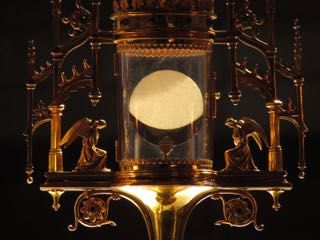
Our Mass times are:
8.15am every day.
Donate
If you would prefer to Donate, you can do so here: